The Consequences of the Armed Revolt by the Russian Mercenary Leader

The latest on the aftermath of the armed rebellion declared by Russian mercenary chief Yevgeny Prigozhin:
——
President Joe Biden and Ukrainian President Volodymyr Zelenskyy spoke by phone on Sunday, a day after a mercenary group’s aborted rebellion in Russia weakened President Vladimir Putin.
Zelenskyy, writing on his Website and Telegram, said they discussed “the course of hostilities and the processes taking place in Russia” and urged that more pressure be put on Russia to restore Ukraine’s borders.
“Yesterday’s events exposed the weakness of Putin’s regime,” Zelenskyy said he told Biden.
 Group-think keeps leading our elites into disaster
The White House said the two leaders discussed Ukraine’s counteroffensive, and that Biden reaffirmed unwavering U.S. support, including through continued security, economic and humanitarian aid.
U.S. Secretary of State Antony Blinken said earlier Sunday the attempted insurrection and now-exiled Wagner chief Yevgeny Prigozhin’s criticism of Russia’s invasion of Ukraine “create more cracks in the Russian facade.”
——
KEY DEVELOPMENTS:
Russian mercenary leader’s exile ends revolt but leaves questions about Putin’s power
Belarus deal to take in leader of Russian rebellion puts him in an even more repressive nation
The mercenary chief who urged an uprising against Russia’s generals has long ties to Putin
Follow AP’s coverage of the war in Ukraine: https://apnews.com/hub/russia-ukraine
___
U.S. Secretary of State Antony Blinken said Sunday the attempted insurrection and now-exiled Wagner chief Yevgeny Prigozhin’s criticism of Russia’s invasion of Ukraine “create more cracks in the Russian facade.”
 Ex-Trump Aide Michael Flynn Deserves Prison Time: Justice Department
Speaking on CBS’s “Face the Nation,” the top U.S. diplomat emphasized that it was an unfolding story and the long-term impacts of the Wagner forces’ now-abandoned march on Moscow would take time to assess, but said it portended more trouble for Russia’s leader.
“We do know that Putin has a lot more to answer for in the weeks and months ahead,” he said.
Asked whether the U.S. was prepared for Putin’s potential fall from power and whether there were concerns about the security of nuclear weapons in its strategic rival, Blinken said: “We always prepare for every contingency.”
“We haven’t seen any change in Russia’s nuclear posture,” he added. “There hasn’t been any change in ours. But it’s something we’re going to watch very, very carefully.”
Blinken declined to address U.S. intelligence as to whether Putin is in Moscow and refused to detail diplomatic engagements between Washington and Russia in the past several days.
“We had some engagement with the Russians over the weekend to make sure they understood their responsibilities when it comes to looking out for the safety and security of our personnel in Russia,” he said.
___
Russian troops deployed to protect the capital withdrew Sunday after mercenary forces headed toward Moscow retreated.
After calling for an armed rebellion aimed at ousting Russia’s defense minister, mercenary chief Yevgeny Prigozhin and his fighters appeared to seize control of the Russian military headquarters in Rostov-on-Don that oversee fighting in Ukraine.
They then advanced towards Moscow largely unhindered. Russian media reported that they downed several helicopters and a military communications plane. The Defense Ministry has not commented.
They were halted only by a deal to send Prigozhin to neighboring Belarus, which has supported Russia’s invasion of Ukraine. Charges against him of mounting an armed rebellion will be dropped, according to Kremlin spokesman Dmitry Peskov, and Prigozhin ordered his troops back to their field camps.
Moscow had braced for the arrival of the Wagner forces by erecting checkpoints with armored vehicles and troops on the city’s southern edge.
There was little sign in Moscow on Sunday of the counterterrorism alert that was introduced after Prigozhin launched his short-lived revolt and nominally remained in place.
Crowds swarmed the downtown area of the Russian capital on a sunny day and street cafés were packed with customers. Traffic had returned to normal and roadblocks and checkpoints were removed.
___
A top Russian diplomat flew to Beijing for talks with the Chinese government on Sunday, a day after the rebellion by a Russian mercenary commander fizzled out.
Russia’s Deputy Foreign Minister Andrei Rudenko met with Chinese Foreign Minister Qin Gang to discuss “international and regional issues of common concern,” the Chinese Foreign Ministry said in a one-line statement on its website.
Rudenko’s visit comes after Yevgeny Prigozhin, the head of the mercenary Wagner Group, ordered his troops to march on Moscow before reaching a deal with the Kremlin on Saturday to go into exile and sounding the retreat.
China has not officially commented on the crisis in Russia.
Russia and China have maintained close ties throughout Moscow’s invasion of Ukraine, which China has refused to condemn.
___
There was little sign in Moscow on Sunday of the counterterrorism alert that was introduced after Yevgeny Prigozhin launched his revolt and nominally remained in place.
Crowds swarmed the downtown area of the Russian capital on a sunny day and street cafés were packed with customers. Traffic had returned to normal and roadblocks and checkpoints were removed.
The “counterterrorist regime” that authorities declared in Moscow and its surroundings allowed restrictions on freedoms and enhanced security.
Anchors on state-controlled television stations cast the deal ending the crisis as a show of President Vladimir Putin’s wisdom and aired footage of the Wagner Group’s troops retreating from Rostov-on-Don in southern Russia. People in Rostov-on-Don who were interviewed by Channel 1 television hailed Putin for defusing the crisis.
——
There are still no reports of mercenary leader Yevgeny Prigozhin arriving in Belarus after he reached a deal with the Kremlin to go into exile and ended his rebellion.
Many other questions remained unanswered on Sunday morning, including whether Prigozhin would be joined in exile by any of his Wagner Group’s troops and what role, if any, he might have there.
Prigozhin, who sent out a series of audio and video updates during his revolt, has gone silent since the Kremlin announced that the deal had been brokered for him to end his march toward Moscow and leave Russia.
——
The U.S.-based think tank Institute for the Study of War says the Kremlin “faces a deeply unstable equilibrium” after the deal to end the rebellion by Yevgeny Prigozhin’s Wagner Group.
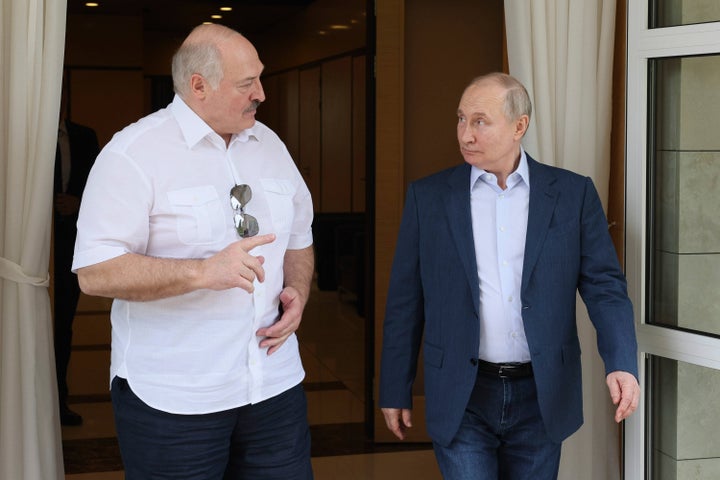
The institute said that the optics of Belarus’ President Alexander Lukashenko having played a role in halting a military advance on Moscow were “humiliating” to Russian President Vladimir Putin.
It said that “the Lukashenko-negotiated deal is a short-term fix, not a long-term solution, and Prigozhin’s rebellion exposed severe weaknesses” in the Kremlin and the Russian Defense Ministry. The Kremlin’s apparent surprise at Prigozhin’s rebellion also doesn’t reflect well on the FSB, Russia’s domestic intelligence service, it added.
The ISW noted that Prigozhin “consistently escalated” his rhetoric against the Russian Defense Ministry before starting his revolt “and Putin failed to mitigate this risk.”
Explore more:
Comments:
comments powered by Disqus